 Film School Secrets: Insider Advice for Aspiring Filmmakers Learn Filmmaking as Creative Professional, Not a Starving Artist
 Most people attend film schools believing they will help them achieve their goals of working in the film business and making movies.
The truth is far different. You’re more than likely setting yourself up to be the next $100,000 joke. Film schools charge up to $40,000 a year to use equipment that rents for only a couple hundred dollars a day. Film school graduate job placement and earnings are very low proportional to the cost of school. And grads do not have the tools or the training to make a feature film.
Film Schools do not provide you with a plan. That is why so many graduates fail. And that is why Stephen Ujaki, Dean of Film & TV at Loyola Merrimount said the “majority of students majoring in film and television will not be having careers in those professions” in a New York Times article dated 7/5/11.
It’s not because there are not jobs to be done in the film business, and it’s not because there aren’t movies to be made. It’s because film schools fail to provide graduates with the practical tools they need to find work, raise money, and make movies.
This site has got the tough love and real answers about you won’t find elsewhere. We want to show you a better way. First, we need to help debunk the myth that you need film school to be get into movies.To that end we have a lot of data, facts, and previously unrevealed information.
Film Schools: A Ginormous Truth Bomb
Film schools aren’t a luxury… the are a liability. Production managers, Producers, and Professionals within the film industry do not take graduates of film schools seriously. Why? Because film is not an academic field. This isn’t law or medicine, or biochemistry, where going to school and having a masters degree gets you ahead. In fact, in the book Film School Confidential, Karin Kelley and Tom Edgar, both NYU Film Graduates write:
“”In many cases, you won’t want to include your MFA on your resume. Ironically, an MFA in film will probably help you more outside of Hollywood than inside… Several people we know, who have MFAs in film and work in film and television production do not include their degrees on their resumes. They found that when that was included on their resumes, they were rarely hired. It was only when they removed the MFA from their resumes that they started getting work.”
Quentin Tarantino, James Cameron, Steven Spielberg, and most of the most powerful people in Hollywood never attended film schools or even college. You may have heard this before, but think about it seriously. More than 90% of the successful professionals in film never went to school, so why do people trying to break into the field keep applying to school?
Part of the reason is marketing, and the cultural misconception that college is necessary to have a successful career. Don’t let your parents or teachers pressure you into going to school and taking out loans without understanding how the business works. Recently, Full Sail ran an ad on Facebook that epitomizes the problem of film schools and other institutes of higher education intentionally overpromising and misleading students into believing investing in their school will lead to a lucrative career.
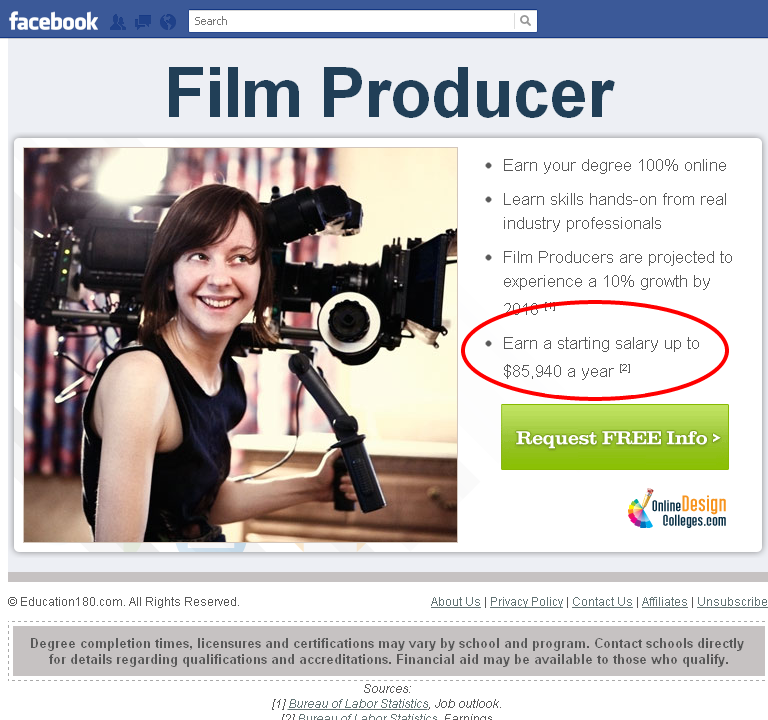
Image Source: Facebook.com
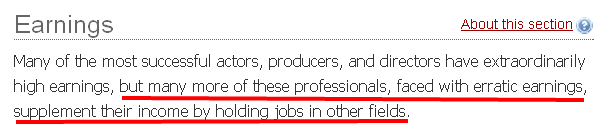
This ad appears to claim that graduates of film schools can earn up to $85,000 a year out of school, based on statistics from the Bureau of Labor Statistics. If you go to the footnote cited, you will see that the average salary for producers in film is $85,000. But this is an average which includes people who produce shows like American Idol, Modern Family, etc. who are making millions. It skews the data. And the actual government website point this out. This is what you find on that page:
Source: http://www.bls.gov/oco/ocos093.htm
That’s right from the Bureau of Labor & Statistics, and the U.S. Government. It speaks the truth. Older non profit film schools like NYU film school and USC film school rarely produce working directors. Newer for profit film schools like New York Film Academy & the Art Institutes don’t either.
Every once in a while, a graduating student makes a feature or wins an award. That’s great, but what about the thousands of other students of film schools that can’t find work and are deeply in debt from their student loans?
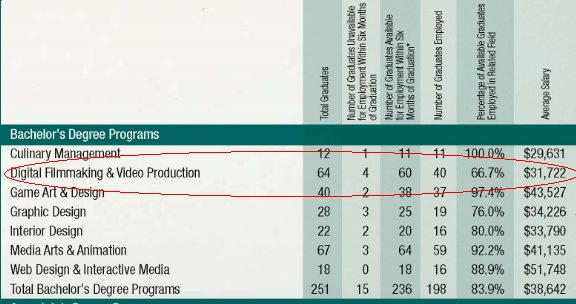
These are actual job placements stats from the Art Institutes. According to them, graduates of one of their $99,000 Film BFA program have a 66% job placement rate and starting salary of $31,000 a year… which is about $460 a week after taxes.
Source: artinstitutes.edu
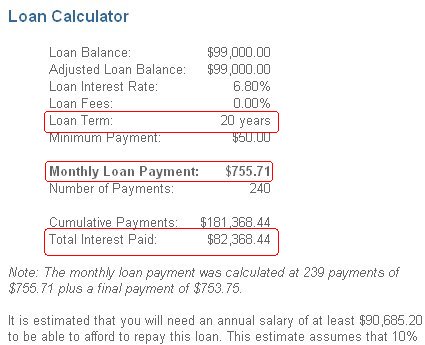
Meanwhile, the monthly payment on a $99,000 student loan is about $755 a month. And it’s recommended you be making $99,000 a year to be able to afford it. Plus you end up paying double your loan in 20 years ($180,000 total) to go through the program.
Source: finanaid.org
What kind of jobs can a film school graduate expect to get? The kind of entry level, basic jobs you wouldn’t give to anyone else. Here’s a sample posting of a typical opportunity from Craigslist:
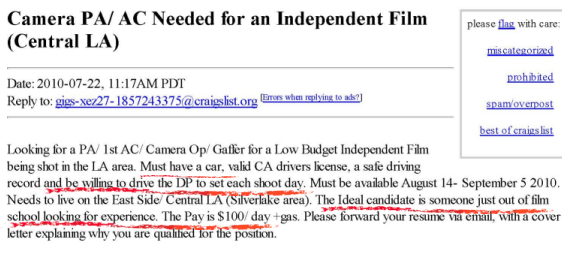
Source: craigslist.org
Kevin Smith, who dropped out of Vancouver Film School and used his tuition money and credit cards to make “Clerks” back in the 90s, included this little truth bomb in his movie “Jay and Silent Bob Strike Back”. It’s a very satirical but truthful look at how film school grads are viewed within the film business:
Film Schools: Equipment Cost, Tuition, Profit
Part 1: Film Programs
Many aspiring filmmakers want to actual use real film instead of digital video. At NYU and USC students wait until their second year, but they do shoot little 16mm films. At NYFA, in the 1 year filmmaking program, students start making 16mm films on day one.

Source: nyfa.edu
That is a testimonial from the NYFA web site. It’s true, nobody is disputing that NYFA provides students with the opportunity to shoot short 16mm films. But most applicants do not understand the nature of the equipment they will be using.
The main camera used in the film program at NYFA, NYU, and USC is the Arriflex-S 16mm Camera, first manufactured in 1960. These cameras haven’t been used in the film industry for many, many years.
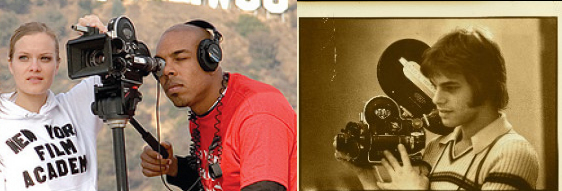
Film schools either have their own in house supply of these old cameras or have students rent them through local production houses. As such, rental rates are surprisingly low. In New York, for instance, there is s rental house called “Hit and Run Productions” that rents these cameras for $150/day.

http://www.hitandrunproductions.com/16mm.htm
The question is, why does it cost so much at film schools like New York Film Academy?
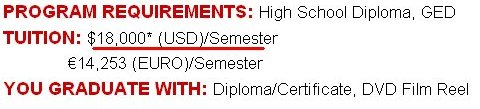
Source: http://www.nyfa.edu/film-school/filmmaking/1year.php
Students at most film schools including NYU and NYFA pay $18,000 a semester or more to use old cameras that can be rented for as little as $150 a day. The film stock for the films can cost a couple hundred dollars. And this is the kind of films they make:
Here’s on from NYU using the same cameras, at a cost of $20,000 a semester:
(Learning to load a 16mm camera and use a light meter takes about 10 minutes to learn). Additionally, students are expected to pay for production costs of their movie on top of tuition at most film schools (?!)
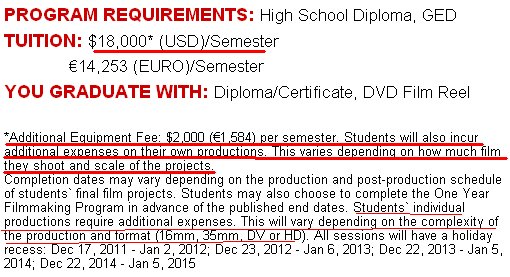
http://www.nyfa.edu/film-school/filmmaking/1year.php
At NYFA, student pay an additional $2,000 equipment fee (for what exactly) plus incur their own expenses on top of tuition, while using (at least for the 1st semester) 50 year old film cameras. Where does the rest of that money go?
NYU and USC film schools also have students pay for their films on top of tuition, which is why some students end up paying an additional $10K to $50K for their films.
Does this make sense to you? It’s your call.
Part 2: Digital
This is where film schools get really crazy. In the last 10 years digital video has increased in quality and the price has dropped drastically, but film schools are still charging insane prices to use equipment you could buy on your own for much less. At the Art Institutes, students are paying $90,000 in a 3 year program to use DSLR cameras you could purchase for $3,000 and editing stations you could buy for under $1,500.
#1: Editing Systems.
Let’s start with editing. At NYFA, it’s right in the school’s documentation, but most people don’t know how to interpret it.

From http://www.nyfa.edu/about/faq.php
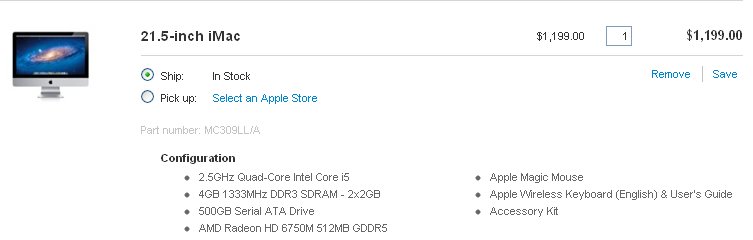
Apple and Final Cut Pro Editing Software revolutionized editing. Back in 1996 an AVID editing system cost $25K and up. Nowadays, you can go to the Mac Store online and buy a Mac like this:
Source: apple.com
And Final Cut Software like this:

Source: apple.com
That’s about $1,200 for a 4GHZ Mac and $300 for the software, about $1500 to purchase your own Final Cut Pro Editing System.
It’s even cheaper if you buy a PC and AVID’s Pinnacle Editing software which is only $90.
Part #2: Digital Cameras
When considering film schools you also have to remember that the digital video cameras they provide are shared by hundreds of other students. You pay a premium to share used equipment, when you could purchase or rent it for much less. According to NYFA (and this is the same at NYU, USC, and Art Institutes), the equipment they provide is like this:

Panasonic DVX and HVX200 cameras. These are the bread and butter of film schools. The Panasonic 35mm cameras and Red One Cameras, which cost a lot more, are available in less numbers and not until you take more advanced courses. These Panasonics are handed out like candy to eager film school students who have no idea just how cheap they are.
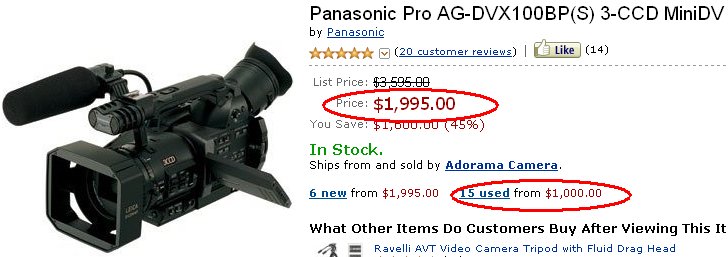
The Panasonic DVX 100b camera was revolutionary… in 2002. Nowadays this camera costs $2000 to buy new, $1000 used (less than many cameras at Best Buy) and uses Standard Definition mini DV tapes. It’s still a nice camera, just outdated. And you can rent one for less than $100 a day.
Source: amazon.com
These DVX cameras are still used in many of the courses offered at film schools throughout the world. But they have more in common with a Fisher Price camera these days than the current modern HD cameras you can buy for less than $3000.
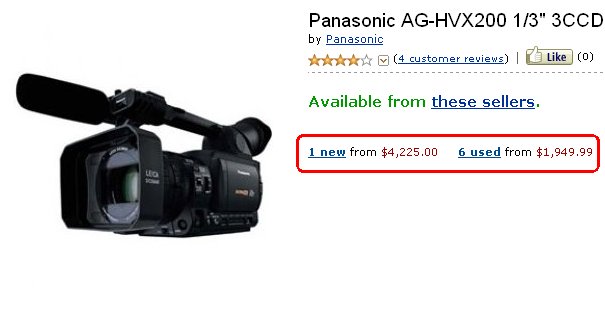
The camera used in the NYFA 4 week digital filmmaking course, according to the school’s website is either the DVX100 or the HVX200. Again, a nice camera. But look at the cost for purchase. And remember, there is a big difference between using a piece of equipment and buying it:
Source: amazon.com
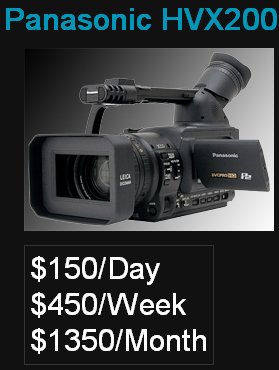
The HVX 200 is $4000 to buy new and as little as $1900 used. The cost keeps dropping. And the rental price is super cheap:
Source: hdpioneers.com
However, I recommend a DSLR camera – because of the interchangeable lenses and sensors, if you want to make cinematic looking images.
Think about this information carefully before taking out a student loan to pay for using one of these cameras for a few weeks.
Okay, What to Do Instead of Film School
We could go on, but this site isn’t about hating on film schools. We need to be critical to get your thinking critically. To learn the right way to begin a directing career, check out our free webinar called ‘The Film School Solution”:
I need to make a bunch of flyers and hand them out at the big film schools, save people’s lives. Its very sad how film school works. I’m 18 and love Gripping, and have already worked on much bigger sets than the film school grad PAs on those low budget projects.
The chris rock video made me chuckle, but its a sad reality. An intern PA I spoke with said she is paying about 95k on an film degree, all she ended up doing was washing dishes and cleaning up on set. I don’t know about you, but I wouldnt pay that much to do janitor work.
Ricky, I checked out your site and this is awesome. You are doing exactly what a guy your age with a passion for film should be doing: working on film sets.
Guys,
You are exactly right on all levels of the film business and especially in regards to education. Film schools know the cost of everything and the value of nothing.
I’ve been in the film and television business 25 years and have some of the best contacts in the the world. I want you to know that I am opening up a small academy (30 students – that’s it) on the east coast. I am teaching kids there are three things they need to succeed–attitude, experience and relationships…not degrees.
Included in a very moderate tuition price will be issuing students their own cameras, editing software and Final Draft script software. In addition I will teach them how to make MONEY on sets by getting them below the line production jobs while still in school. I will teach them how to write business plans and how to handle finances. I will bring them to LA and show them where to live and how to get around, I will use my relationships to bring producers, directors and below the line experts for seminars and teach them the truth about the business and how to navigate it.
I’m never going bigger, I will only go better because it’s not about the money it’s about helping people succeed without being $100k in debt the rest of their lives. You guys get it. Don’t think of me as a competitor because as the truth unfolds to kids, we will be at the forefront of education in the business. Continued success in your program.
Hello,
What is the name of your website? I would love to take a look at what you are teaching. I am currently a junior in high school looking to pursue a career in film and your teachings sound like the perfect way to help me start up a career.
I go to film school and I will be graduating in a few months. I agree on something on this article and then I disagree on some of it. I don’t pay $100,000 for film school. I advise if you have the money to go to film school then go. Most people know that college degrees are beneficial if you want to work in most fields so why not get a degree in something that you have a love for. I don’t knock that. Film school allows you to network with a lot of people and it increases your contacts and teaches you how to work with people on set.
Most production companies will not let a person intern if they are not a student seeking a college credit for it otherwise you’re just a random unsolicited. Steven Spielberg went to California State and so did James Cameron. Tarantino did not.
It totally depends on your networking skills and who you know. A film degree is not going to get you a job your skills are whats going to get you a job, but film school is a big help because you learn everything you could every know and shoot your thesis films, demo reels, and anything everyday to have better work then the do it your selfers to get you the better job.
The teachers who teach at film schools are professionals who have worked in they field and they usually recommend their students to get in first because they have contacts to the big people. Many have come to our school already.
I agree film school can be overrated and down right expensive but it does have its perks.
Thanks for the reply Amber. Unfortunately most of what you are saying just isn’t true. Film School teaches you how to work on student film sets, which is like riding a bike with training wheels for a few years. A student film set it a bad place to learn – it’s better to just get on a pro set and learn from professionals.
I interned on my first feature film at age 17 when I was still in high school. Nobody cares if you are in film school are not – if you are willing to help out you can get on a film set. Spielberg’s time at Cal State had nothing to do with his film career. “His actual career began when he returned to Universal Studios as an unpaid, seven-day-a-week intern and guest of the editing department (uncredited). After Spielberg became famous, USC awarded him an honorary degree in 1994, and in 1996 he became a trustee of the university.[16][17] In 2002, thirty-five years after starting college, Spielberg finished his degree via independent projects at CSULB, and was awarded a B.A. in Film Production and Electronic Arts with an option in Film/Video Production.[17]” from Wikipedia.
Cameron went to a community college in Fullerton and used to sneak into the USC library. He got his hands on a camera with some friends and took it apart, wrote his own film, taught himself how to shoot a film – was working as a special effects supervisor when he started shooting his own films and got his vision for “The Terminator”. He hustled his ass off to get that funded then shot it and started his career. School played absolutely NO part in that, and in an interview in 1996 Cameron said “The best hing that ever happened is I didn’t go to film school”. You can read the interview here:
http://www.industrycentral.net/director_interviews/JC01.HTM
Networking is irrelevant if you want to be a feature film director. Film Schools don’t teach you how to make or market a feature — they provide some kindergarten experience then send you out into the industry to try and fight for a PA gig.
What is left out is that a college education is still attained. I worked in post after graduating college and from there worked for several years at WB and Sony Pictures. I got my start in post through my film school connections. Wouldn’t change it.
Thanks Kyle, for the comment. But you and I both know the degree is meaningless – do your colleagues have degrees? Back in the 80s and 90s it may have been a good way to make an inroad but these days it is absurd to pay six figures to make a connection. For every person who got a connection due to a degree there are 5 others who got their way into a position through non college related connections. And that’s in post – i’m referring in the article primarily to directing, which is the path most film school applicants wish to pursue, and for which there is no connection to get a gig. It is based purely on what you can produce and hustle.